Watch the 2-minute setup
LT Plumbline is a block theme for plumbers, heating engineers and home-repair services. See it live in the demo.
Section patterns (Pro)
| Pattern | Use it for |
|---|---|
| Hero with callout request card | Deep blue hero with headline, buttons, trust points and common jobs with example starting prices. |
| Services grid | Eight service cards with icon tiles: leaks, drains, boilers and water heaters, bathrooms, emergencies, gas safety checks, radiators, inspections. |
| How it works | Four steps from the first call to a finished job. |
| Company in numbers | Four key numbers on a dark band. |
| About the company | Illustration of a plumber at work, your story and a checklist. |
| Bathroom installations | Bathroom refit story with a checklist, a button and an illustration. |
| Current offers | Three coupon-style offer cards. |
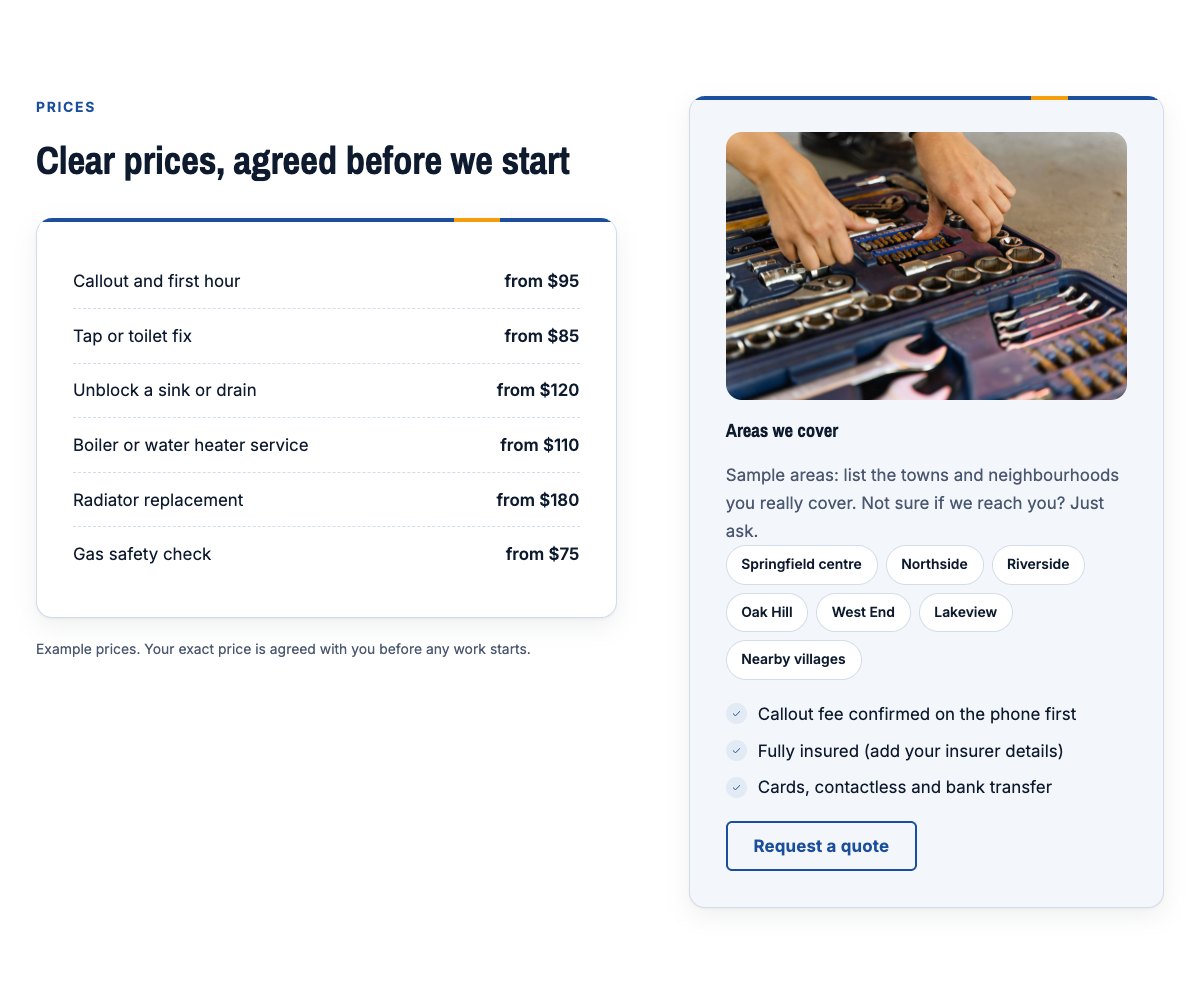
| Price list and areas served | Price list next to the areas you cover and payment options. |
| Emergency banner | Highlighted strip for your emergency phone line. |
| Our engineers | Team cards with photo, role and bio. |
| Customer reviews | Three review cards (use real reviews only). |
| Frequently asked questions | Expandable questions about callout fees, emergencies, guarantees and gas work. |
| Office hours and location | Hours, address, phone and a map with directions. |
| Contact cards | Call, email and find-the-office cards. |
| Book a plumber call to action | Deep blue band with booking and phone buttons. |
Page layouts (Pro)
- Home page: the complete homepage.
- Services page: services, how it works, bathroom installations, offers, prices and areas, emergency banner and FAQ.
- About page: your story, numbers, how it works, engineers and reviews.
- Contact page: contact cards, emergency banner, office hours and map.
Demo content to replace
- Phone
(555) 014-3806, email[email protected]and the Elm Street address (header, footer, hero, contact sections). - Office hours (top bar, footer, hours section) and the “24/7” emergency line (numbers band, emergency banner, FAQ).
- Starting prices in the hero card and the price list; the sample areas you cover; the three offers.
- Placeholders in brackets such as “Licensed & insured (add your details)” and “Workmanship guarantee (your terms)”, and the sample FAQ answers about callout fees and guarantees.
- Company numbers and rating; engineer names, roles and photos; sample reviews.
- The “Book a plumber” and “Request a callout” buttons: link them to your booking system or form.
Only mention licences, insurance, gas engineer registrations, guarantees and emergency hours your business really has. Gas work must be carried out by a qualified gas engineer: add your own registration details, never example ones.
Photo guide
Replace the illustrations and placeholder portraits with your own photos: select the image in the editor, then Replace. These sizes look sharp on large screens without slowing the site down.
| Image | Shape | Upload size | Tips |
|---|---|---|---|
| About photo | Landscape 5:4 | 1600 × 1280 px | An engineer at work in a customer’s home, for example fixing a sink or a boiler. |
| Bathroom photo | Landscape 5:4 | 1600 × 1280 px | A bathroom you fitted, photographed in daylight with the room tidy. |
| Areas served photo | Landscape 5:4 | 1600 × 1280 px | Your van, your tools or the team on the way to a job. Blur or remove other people’s number plates and addresses. |
| Engineer photos | Portrait 4:5 | 800 × 1000 px | Head and shoulders in work clothes, same background for everyone. |
| Map picture | Landscape 3:2 | 1600 × 1040 px | A screenshot of your map, or keep the illustration; the button links to Google Maps. |
| Blog featured images | Landscape 3:2 | 1600 × 1067 px | Shown on the blog cards and at the top of each post. |
| Logo (header and footer) | Wide or square | At least 200 px tall, PNG with a transparent background or SVG | Shown about 44 px tall. Set it in Appearance → Editor: select the logo block. |
| Site icon | Square | 512 × 512 px | The small icon in browser tabs. Settings → General → Site Icon. |
- Save photos as JPEG or WebP and keep each file under about 300 KB (a free tool such as squoosh.app does this).
- WordPress crops to the shape for you: select the image → Crop in the toolbar to choose which part shows.
- Fill in the Alternative text of each photo (for example “Our reception desk”) for accessibility and Google.
- Only use photos you own or have permission for. Ask clients before you publish photos of them.
Colour styles
Default (deep blue and safety orange), Copper, Boiler Red and Slate. Try them in the live demo with the colour dots in the top bar.