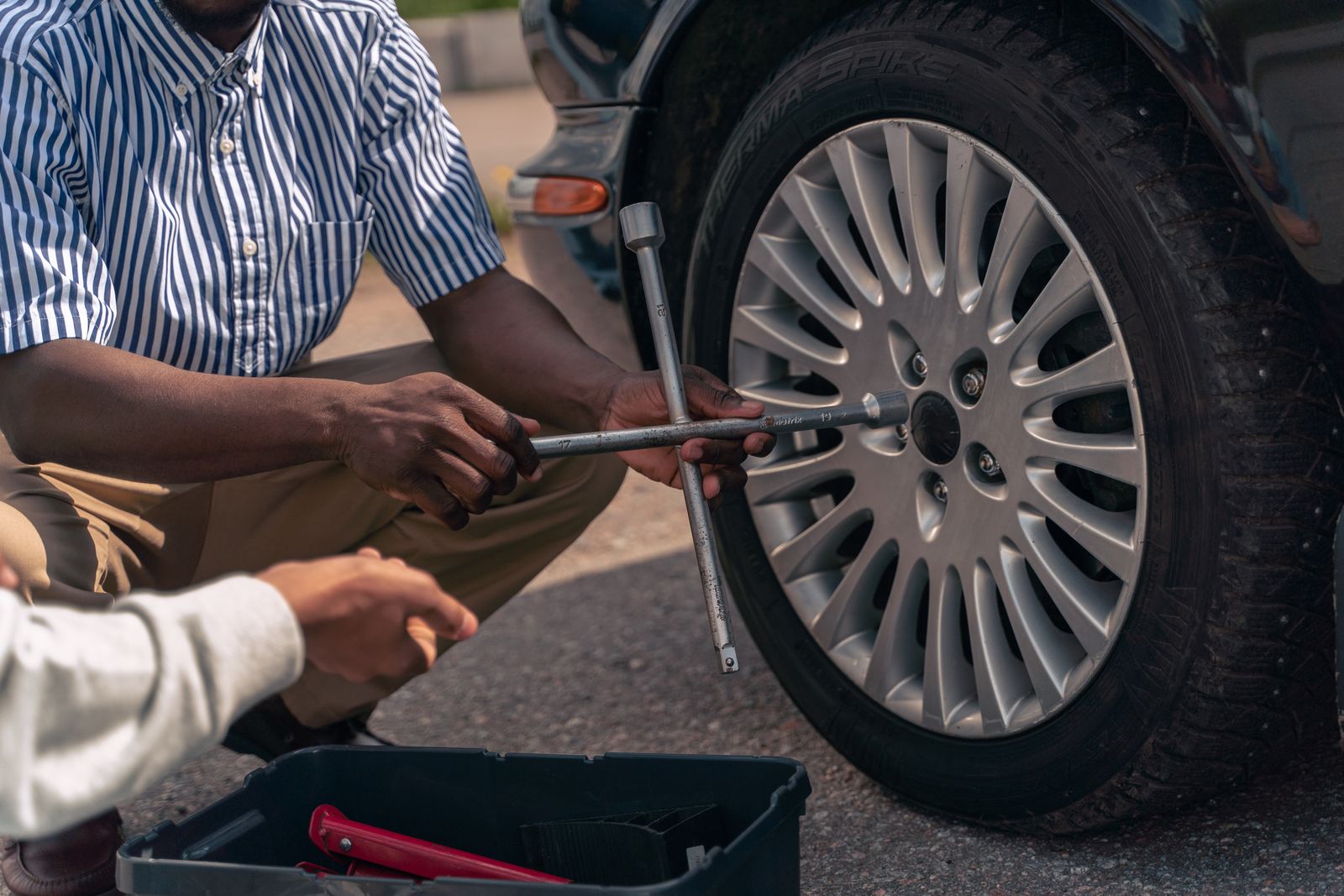
A flat tyre rarely comes at a good time. Whether you change it yourself depends far more on where you have stopped than on how handy you are.
First, get somewhere safe
Driving a short distance slowly on a flat tyre to reach a safe, level spot is better than stopping on a narrow shoulder or a bend. Switch on your hazard lights and put the parking brake on.
Change it yourself only if
- You are well away from moving traffic, on firm, level ground.
- You have a usable spare (or space-saver), a jack and a wheel brace, and you know where the locking wheel nut key is.
- It is light enough to see, and you feel confident doing it.
On a motorway or fast road shoulder, do not try to change a wheel yourself. Get out on the side away from traffic, wait behind the barrier and call for help.
The basic steps
- Loosen the wheel nuts slightly while the wheel is still on the ground.
- Jack the car up at the lifting point shown in the handbook. Never put any part of your body under the car.
- Remove the nuts and the wheel, fit the spare, and tighten the nuts by hand.
- Lower the car, then tighten the nuts firmly in a criss-cross order.
- Check the spare’s pressure as soon as you can, and keep to the speed limit printed on a space-saver.
When to call instead
- There is no spare, the spare is flat, or the car has a tyre repair kit you are not sure about.
- A wheel nut will not move or the locking key is missing.
- More than one tyre is damaged, or the wheel itself is bent.
A roadside tyre change takes most of the risk out of it, and if the tyre cannot be fixed at the roadside, the car can be towed to a tyre shop.