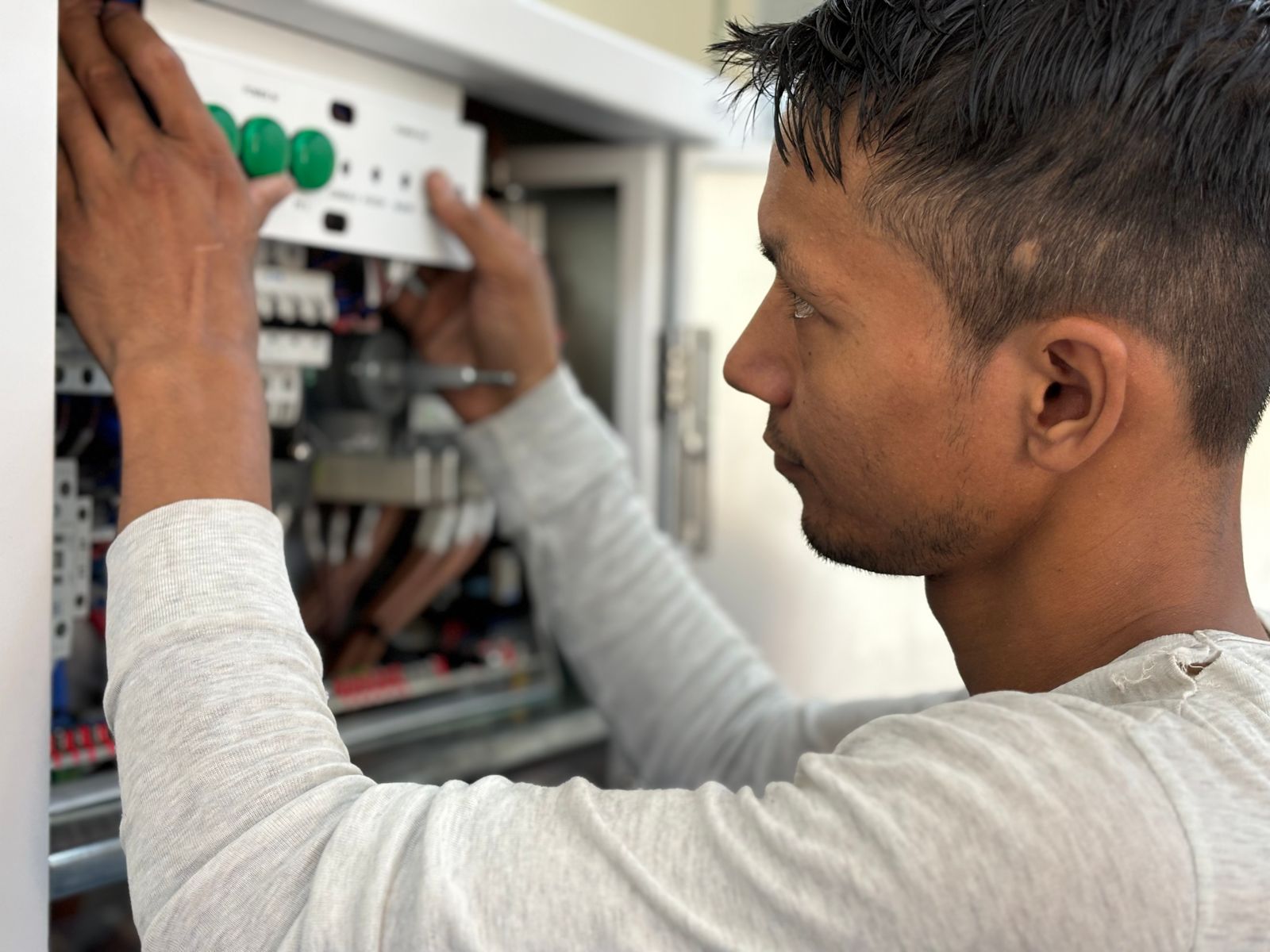
The electrical panel (also called a breaker box or service panel) takes the power coming into your home and splits it into the circuits that feed your lights, outlets and appliances. Panels last a long time, but many homes now ask far more of them than they were built for.
Signs your panel needs a closer look
- Breakers trip often, especially when two big appliances run at the same time.
- Lights dim or flicker when the microwave, dryer or air conditioner switches on.
- The panel feels warm, buzzes or smells of burning, or you can see rust or scorch marks on it.
- You still have a fuse box, or a panel that is several decades old.
- You rely on power strips and extension cords because there are not enough outlets or circuits.
When you are adding something big
An EV charger, a heat pump, an induction range, a hot tub or a kitchen renovation can each add a large new load. Many older homes have 100-amp service, while many newer homes are built with 200 amps. An electrician can do a load calculation to see whether your existing panel has room, or whether you need a larger panel or a service upgrade.
What an upgrade involves
- An electrician inspects the panel and your incoming service, and gives you a written quote.
- A permit is arranged where your city requires one. A service upgrade may also need your utility company to disconnect and reconnect the power.
- On the day, the power is off for several hours while the old panel is replaced and each circuit is connected and labelled.
- The work is tested, and an inspector may visit to check it before it is signed off.
Stay safe
Never remove the panel cover or work inside the panel yourself: parts of it stay live even with the main breaker off. If your panel is hot, sparking or smells of burning, keep clear and call an electrician straight away. If there is smoke or fire, leave the building and call 911.